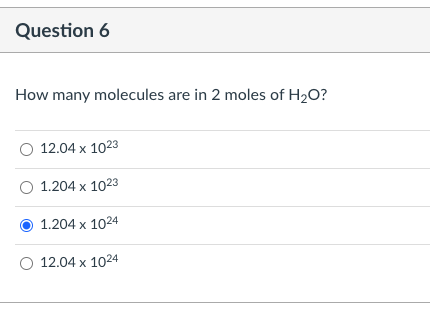
how many grams does 1.204 × 1024 molecules of h 2 o weigh rounded
Table of Contents
- Quantifying Water at the Molecular Scale: Converting Molecules of H₂O to Grams
- Foundational Concepts: Moles, Avogadro’s Number, and Their Role in Quantifying Substances
- Step-by-Step Conversion: From Molecules of H₂O to Moles and Grams
- Common Misconceptions About Avogadro’s Number and How to Clarify Them
- Step-by-Step Calculation: Converting Molecules of H₂O to Grams
- Detailed Procedure for Conversion
- Mathematical Breakdown of the Calculation
- Handling Scientific Notation and Potential Pitfalls
- Role of Significant Figures and Rounding
- Relating the Result to Everyday Examples
- Practical Applications of Converting Molecules of H₂O to Grams: Real-World Impact and Precision in Science
- Industries Where Molecular-to-Mass Conversions Are Critical
- Laboratory Applications: Preparing Solutions and Ensuring Reproducibility
Behind every sip of water lies a hidden world of atomic precision where numbers dictate reality. When chemists ask how many grams is 1.204 × 10²⁴ molecules of H₂O, they unlock a gateway to understanding how microscopic particles translate into measurable quantities that shape industries, medicine, and even climate science. This seemingly abstract question bridges the gap between the invisible—individual water molecules darting at speeds of hundreds of meters per second—and the tangible, like the weight of a single raindrop or the dosage in a life-saving IV drip.
The answer hinges on Avogadro’s number, a constant as fundamental to chemistry as gravity is to physics. Named after the 19th-century Italian scientist who proposed it, this number—6.022 × 10²³—serves as the Rosetta Stone for converting between atoms, molecules, and grams. Yet for 1.204 × 10²⁴ molecules of H₂O, a quantity double Avogadro’s benchmark, the calculation becomes a test of precision. Missteps here could mean the difference between a correctly calibrated pharmaceutical batch and one that fails critical standards. Dive into the step-by-step math, real-world applications, and why this conversion is more than an academic exercise—it’s a cornerstone of modern science.

Quantifying Water at the Molecular Scale: Converting Molecules of H₂O to Grams
Understanding how to translate the abstract count of water molecules—such as 1.204 × 10²⁴—into a tangible mass in grams requires mastering three foundational concepts in chemistry: molecules, moles, and Avogadro’s number. These concepts serve as the bridge between the invisible world of atomic particles and the measurable quantities used in laboratories, industries, and everyday applications. For instance, calculating the mass of water derived from a specific number of molecules is not just an academic exercise but has practical implications in fields like pharmacology, environmental science, and even culinary arts, where precise measurements are critical. This exploration delves into the mechanics of these conversions, demystifying the process while emphasizing the role of Avogadro’s number as the cornerstone of stoichiometry.
Foundational Concepts: Moles, Avogadro’s Number, and Their Role in Quantifying Substances
 The mole (mol) is the standard unit of measurement in chemistry for quantifying the amount of a substance, analogous to how a dozen represents 12 items. One mole of any substance contains 6.022 × 10²³ elementary entities—whether atoms, molecules, ions, or electrons—an quantity known as Avogadro’s number. This number, named after the Italian scientist Amedeo Avogadro, was first proposed in 1811 to explain the relationship between volume and the number of particles in a gas. Avogadro’s hypothesis laid the groundwork for modern chemistry by providing a consistent method to count particles, which was later experimentally verified by Jean Perrin in the early 20th century through studies on Brownian motion.
For water (H₂O), a molecule composed of two hydrogen atoms and one oxygen atom, Avogadro’s number becomes particularly relevant. When dealing with water, the mole serves as a scaffolding to convert between molecules, moles, and grams, enabling chemists to scale reactions, determine concentrations, and analyze compositions with precision. For example, one mole of water molecules weighs 18.015 grams, a value derived from the atomic masses of hydrogen (1.008 g/mol) and oxygen (16.00 g/mol). This relationship is critical in applications ranging from calculating the water content in pharmaceutical formulations to assessing the environmental impact of pollutants dissolved in aqueous solutions.
The mole (mol) is the standard unit of measurement in chemistry for quantifying the amount of a substance, analogous to how a dozen represents 12 items. One mole of any substance contains 6.022 × 10²³ elementary entities—whether atoms, molecules, ions, or electrons—an quantity known as Avogadro’s number. This number, named after the Italian scientist Amedeo Avogadro, was first proposed in 1811 to explain the relationship between volume and the number of particles in a gas. Avogadro’s hypothesis laid the groundwork for modern chemistry by providing a consistent method to count particles, which was later experimentally verified by Jean Perrin in the early 20th century through studies on Brownian motion.
For water (H₂O), a molecule composed of two hydrogen atoms and one oxygen atom, Avogadro’s number becomes particularly relevant. When dealing with water, the mole serves as a scaffolding to convert between molecules, moles, and grams, enabling chemists to scale reactions, determine concentrations, and analyze compositions with precision. For example, one mole of water molecules weighs 18.015 grams, a value derived from the atomic masses of hydrogen (1.008 g/mol) and oxygen (16.00 g/mol). This relationship is critical in applications ranging from calculating the water content in pharmaceutical formulations to assessing the environmental impact of pollutants dissolved in aqueous solutions.
Step-by-Step Conversion: From Molecules of H₂O to Moles and Grams
Converting a given number of molecules—such as 1.204 × 10²⁴—into grams involves a structured approach that leverages Avogadro’s number and the molecular weight of water. Below is a comparison table that outlines the conversion factors, provides example calculations, and offers real-world analogies to contextualize the process.
| Unit | Conversion Factor | Example Calculation for H₂O | Real-World Analogy |
|---|---|---|---|
| Molecules → Moles | Divide by Avogadro’s number (6.022 × 10²³ molecules/mol) |
Calculation: (1.204 × 10²⁴ molecules) / (6.022 × 10²³ molecules/mol) ≈ 1.999 moles 
Rounded: 2.00 moles |
Counting dozens of eggs: If you have 72 eggs, you divide by 12 to find there are 6 dozen eggs. Similarly, molecules are grouped into moles. |
| Moles → Grams | Multiply by molecular weight (18.015 g/mol for H₂O) |
Calculation: 2.00 moles × 18.015 g/mol ≈ 36.03 grams Rounded: 36 grams |
Weighing a bag of flour: If a bag labeled "5 kg" of flour is divided into 10 equal portions, each portion weighs 0.5 kg. Here, moles are the "bags," and grams are the "portions." |
| Direct Conversion: Molecules → Grams | (Number of molecules / Avogadro’s number) × Molecular weight |
Calculation: [(1.204 × 10²⁴) / (6.022 × 10²³)] × 18.015 ≈ 36.03 grams |
Assembling a puzzle: Each piece (molecule) contributes to the final picture (grams), but you need to know how many pieces make up the whole image. |
To convert molecules to moles, follow these steps: 1. Identify the number of molecules: In this case, 1.204 × 10²⁴ molecules of H₂O. 2. Divide by Avogadro’s number: This converts molecules into moles.
3. Round to significant figures: Given the precision of the input, rounding to 2.00 moles is appropriate. 4. Multiply by the molecular weight of H₂O: The molecular weight of water is 18.015 g/mol, derived from the sum of its constituent atoms.
5. Round the final mass: Depending on the required precision, the mass can be rounded to 36 grams. For a deeper understanding, consider the mass of a single H₂O molecule. To find this, divide the molecular weight of water by Avogadro’s number:
This value illustrates the minuscule scale at which individual molecules operate, yet collectively, they form the measurable quantities we encounter daily.
Common Misconceptions About Avogadro’s Number and How to Clarify Them
Avogadro’s number is often conflated with other large-number constants in physics and mathematics, leading to misunderstandings. Below are three prevalent misconceptions and their clarifications: 1. Confusing Avogadro’s Number with Planck’s Constant
2. Believing Avogadro’s Number is Arbitrary
3. Assuming Avogadro’s Number Applies Only to Gases
Step-by-Step Calculation: Converting Molecules of H₂O to Grams
Understanding how to convert the number of molecules of a substance—such as water (H₂O)—into a measurable mass in grams is a foundational skill in chemistry. This process bridges the microscopic world of individual molecules with the macroscopic quantities we encounter daily. The conversion relies on two critical constants: Avogadro’s number, which defines the number of entities (atoms, molecules, or ions) in one mole of a substance, and the molar mass of the substance, which quantifies the mass of one mole in grams. For 1.204 × 10²⁴ molecules of H₂O, this calculation involves transforming an astronomically large number of molecules into a tangible mass, rounded to the nearest whole number for practicality. The steps outlined below ensure clarity, precision, and an awareness of potential errors that often arise in such conversions.
Detailed Procedure for Conversion
The conversion from molecules to grams follows a structured approach, leveraging dimensional analysis to systematically cancel out units until the desired unit (grams) remains. Below is a numbered procedure that breaks down the process into manageable stages, each with an explanation of its purpose and the mathematical operations involved.
-
Convert molecules of H₂O to moles using Avogadro’s number.
Avogadro’s number, 6.022 × 10²³ molecules/mol, serves as the conversion factor between molecules and moles. This step transforms the given quantity of molecules into moles, a unit that directly connects to the molar mass of the substance.
Formula: \[ \text{moles of H₂O} = \frac{\text{number of molecules}}{\text{Avogadro’s number}} \]
-
Calculate the mass in grams using the molar mass of H₂O.
Once the number of moles is determined, multiply by the molar mass of H₂O (approximately 18.015 g/mol) to obtain the mass in grams. The molar mass is derived from the atomic masses of hydrogen and oxygen, accounting for the two hydrogen atoms and one oxygen atom in each H₂O molecule.
Formula: \[ \text{mass of H₂O (g)} = \text{moles of H₂O} \times \text{molar mass of H₂O (g/mol)} \]
- Round the result to the nearest whole number. The final step involves rounding the calculated mass to the nearest whole number, as specified. This rounding is appropriate given the precision of the initial measurement (1.204 × 10²⁴ molecules) and the context in which such calculations are typically applied.
Mathematical Breakdown of the Calculation
The following table provides a detailed step-by-step calculation for converting 1.204 × 10²⁴ molecules of H₂O to grams. Each column explains the process, substitution of values, intermediate calculations, and the resulting value at each stage.
| Step | Formula | Substitution | Calculation | Result |
|---|---|---|---|---|
| 1 | Moles of H₂O = (Number of molecules) / (Avogadro’s number) | (1.204 × 10²⁴ molecules) / (6.022 × 10²³ molecules/mol) | Divide the coefficients and subtract the exponents: (1.204 / 6.022) × 10^(24-23) = 0.1999 × 10¹ = 1.999 mol | 1.999 mol |
| 2 | Mass of H₂O (g) = Moles of H₂O × Molar mass of H₂O | 1.999 mol × 18.015 g/mol | Multiply the moles by the molar mass: 1.999 × 18.015 ≈ 36.011985 g | 36.011985 g |
| 3 | Rounding to the nearest whole number | 36.011985 g | The decimal part (0.011985) is less than 0.5, so round down. | 36 g |
Handling Scientific Notation and Potential Pitfalls
Working with scientific notation, such as 1.204 × 10²⁴, requires careful attention to the placement of decimal points and exponents. Missteps in this area can lead to significant errors in the final result. Below are key considerations and common mistakes to avoid:
-
Misplacing the decimal point or exponent.
When dividing or multiplying numbers in scientific notation, ensure that the exponents are correctly adjusted. For example, dividing 1.204 × 10²⁴ by 6.022 × 10²³ involves subtracting the exponents (24 - 23 = 1) and dividing the coefficients (1.204 / 6.022). Failing to adjust the exponent properly can result in an incorrect order of magnitude.
Example of Correct Calculation: \[ \frac{1.204 \times 10^{24}}{6.022 \times 10^{23}} = 0.1999 \times 10^{1} = 1.999 \times 10^{0} = 1.999 \text{ mol} \]
- Incorrectly rounding intermediate results. Premature rounding can introduce cumulative errors. For instance, rounding 1.999 mol to 2 mol before multiplying by the molar mass would yield a less accurate final result (2 × 18.015 = 36.03 g vs. 36.011985 g). It is advisable to retain intermediate precision until the final rounding step.
- Using an incorrect value for Avogadro’s number or molar mass. Avogadro’s number is 6.022 × 10²³ molecules/mol, not 6.022 × 10²⁴ or any other value. Similarly, the molar mass of H₂O is 18.015 g/mol, not 18 g/mol (unless specified for simplicity). Using incorrect constants will propagate errors throughout the calculation.
Role of Significant Figures and Rounding
The precision of the final result is influenced by the significant figures in the initial measurement and the constants used. In this case, 1.204 × 10²⁴ molecules has four significant figures, while Avogadro’s number (6.022 × 10²³) and the molar mass of H₂O (18.015 g/mol) also have four significant figures. The rule for multiplication and division states that the result should have the same number of significant figures as the measurement with the fewest significant figures. Here, all values have four significant figures, so the intermediate result (1.999 mol) retains four significant figures. Rounding to the nearest whole number (36 g) is appropriate because:
Relating the Result to Everyday Examples
To contextualize the calculated mass of 36 grams of H₂O, consider the following relatable comparisons:
36 grams of water is approximately equivalent to:
- 1.5 tablespoons of water, which is
Practical Applications of Converting Molecules of H₂O to Grams: Real-World Impact and Precision in Science
Understanding how to convert molecular quantities—such as 1.204 × 10²⁴ molecules of H₂O—into grams is not merely an academic exercise but a cornerstone of precision across industries where accuracy can mean the difference between success and failure. From life-saving pharmaceutical formulations to environmental monitoring and food safety, these calculations ensure consistency, compliance, and safety. The ability to quantify water at the molecular level leverages its unique properties—such as high polarity, hydrogen bonding, and universal solvent capabilities—to solve critical challenges in chemistry, biology, and engineering. This section explores the real-world applications where such conversions are indispensable, highlighting industries, laboratory practices, and technological dependencies that rely on these foundational calculations.Industries Where Molecular-to-Mass Conversions Are Critical
The conversion of molecular quantities to grams is a non-negotiable step in fields where precision directly impacts human health, environmental stability, and industrial efficiency. Below are key industries where these calculations underpin operations, along with specific use cases and the rationale behind their necessity.Key Principle: The molar mass of H₂O (18.015 g/mol) serves as the bridge between Avogadro’s number (6.022 × 10²³ molecules/mol) and measurable mass, enabling cross-disciplinary accuracy.
Industry Specific Use Case Why Molecular-to-Mass Conversions Are Essential Pharmaceuticals Dosage calculations for intravenous (IV) solutions (e.g., saline, dextrose).
- Ensures therapeutic efficacy by delivering precise concentrations of active ingredients.
- Prevents toxic overdoses or ineffective treatments due to miscalculated hydration levels.
- Regulatory bodies (e.g., FDA, EMA) mandate molarity-based formulations for drug approval.
Preparation of buffered solutions for drug stability.
- Water’s pH-buffering role (e.g., in phosphate-buffered saline, PBS) relies on exact H₂O molarity.
- Incorrect conversions can alter drug solubility or protein denaturation in biologics.
Lyophilization (freeze-drying) of vaccines.
- Water content must be precisely controlled to maintain vaccine integrity during storage.
- Molecular calculations determine residual moisture limits, critical for shelf-life extension.
Environmental Science Measuring parts-per-million (ppm) water vapor in air or soil samples.
- Critical for climate modeling and pollution studies (e.g., humidity’s impact on particulate matter).
- Incorrect conversions can lead to underreporting of drought risks or overestimation of contaminant dilution.
Assessing hydration states in wastewater treatment.
- Water’s hydrogen bonding network affects microbial activity in sludge digestion.
- Molarity-based calculations optimize biochemical oxygen demand (BOD) measurements.
Food Industry Determining water activity (aw) in processed foods.
- Regulates microbial growth (e.g., in baked goods, jerky) via H₂O molecular availability.
- Labeling compliance requires mass-based moisture content (e.g., "90% natural juice").
Formulating emulsions and beverages (e.g., milk, soda).
- Water’s solvent properties dictate flavor stability and texture; molecular calculations ensure consistent viscosity.
- Incorrect H₂O molarity can cause phase separation in dressings or carbonation loss in drinks.
Chemical Engineering Designing cooling towers or steam generation systems.
- Water’s latent heat of vaporization (540 cal/g) requires precise mass calculations for energy efficiency.
- Molarity adjustments prevent scaling (mineral deposition) in pipes.
Synthesizing hydrated salts (e.g., CuSO₄·5H₂O).
- The stoichiometry of water molecules in crystalline structures must match theoretical molar masses.
- Deviations lead to impure products or structural failures in materials science.
Laboratory Applications: Preparing Solutions and Ensuring Reproducibility
In laboratory settings, the conversion of molecular quantities to grams is the bedrock of experimental reproducibility. Solutions—whether aqueous buffers, reagent stocks, or calibration standards—demand molarity-based precision to achieve consistent results. Below are key laboratory practices where these calculations are non-negotiable.Laboratory Standard: The International Union of Pure and Applied Chemistry (IUPAC) mandates molar-based preparations for all analytical chemistry protocols.
- Buffer Preparation for pH Control Water’s amphoteric nature (acting as both acid and base) makes it ideal for buffering systems. For example:
- Phosphate-buffered saline (PBS) requires exact H₂O molarity to maintain pH 7.4, critical for cell culture viability.
- Tris-HCl buffers in molecular biology rely on H₂O’s dielectric constant to stabilize nucleic acids.
- Incorrect conversions can shift pH by ±0.5 units, denaturing proteins or inactivating enzymes.
- Molarity Calculations for Titrations Acid-base titrations (e.g., HCl vs. NaOH) depend on stoichiometric water interactions. For instance:
- A 0.1 M NaOH solution must account for H₂O’s autoionization (Kw = 1.0 × 10⁻¹⁴ at 25°C) to avoid titration errors.
- In complexometric titrations (e.g., EDTA for Ca²⁺), water’s ligand-binding sites require precise molarity.
- Calibration of Analytical Instruments Mass spectrometers and chromatographs use water-based standards for calibration. For example:
- Electrospray ionization (ESI-MS) relies on H₂O clusters to ionize samples; incorrect molarity distorts mass spectra.
- High-performance liquid chromatography (HPLC) mobile phases (e.g., acetonitrile:H₂O) need exact ratios to separate analytes.
- Synthesis of Hydrated Compounds Many chemical reactions produce hydrates (e.g., MgSO₄·7H₂O). The mass of water in these compounds must align with theoretical calculations to:
From the lab bench to the factory floor, the conversion of molecules to grams is a silent force ensuring accuracy in everything from drinking water purity to cancer treatments. The 1.204 × 10²⁴ molecules of H₂O in question don’t just yield a number—they reveal how chemistry’s invisible language translates into the physical world we interact with daily. Mastering this calculation isn’t just about solving equations; it’s about grasping the invisible threads that connect atomic-scale precision to the tangible outcomes shaping our lives. Whether you’re a student deciphering textbook problems or a professional relying on exact measurements, the journey from molecules to grams underscores one truth: science’s most powerful tools often begin with a single, carefully placed number.
- Avoid phase impurities in pharmaceutical excipients.
- Ensure thermal stability in materials like cement (where water content affects setting time).
Leave a Comment
Comments are moderated before appearing. The data you submit is processed according to the Privacy Policy of Cloudpbx.